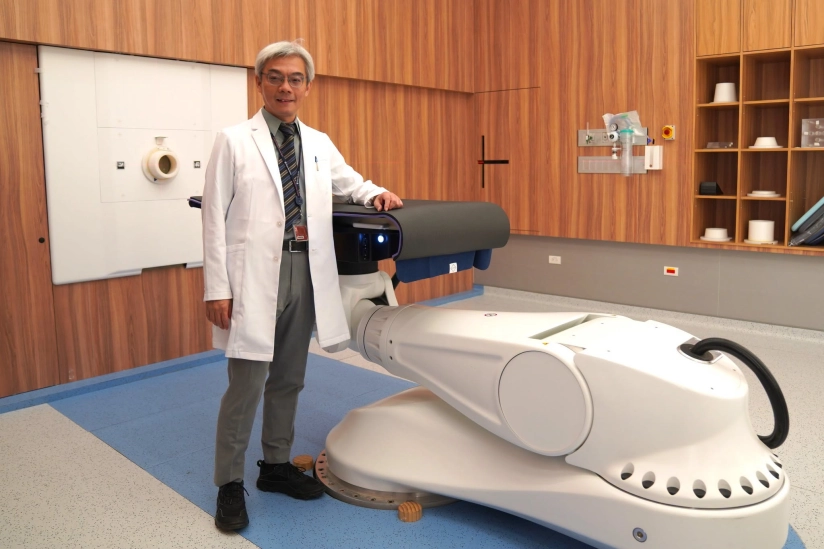

CMUH Hsinchu Completes First BNCT Compassionate Use Treatment
2026-07-28
Source:UDN
CMUH Hsinchu Completes First BNCT Compassionate Use Treatment in Collaboration with Heron Neutron Medical
China Medical University Hsinchu Hospital (CMUH Hsinchu) applied to the Ministry of Health and Welfare for two Boron Neutron Capture Therapy (BNCT) compassionate use cases and has successfully completed treatment for both patients.
According to Dr. Yu-Cheng Kuo, Director of the Department of Radiation Oncology at CMUH Hsinchu, the first case involved a 36-year-old male patient with head and neck lymphoma. The tumor was located in the lower jaw region. Following chemotherapy and radiotherapy, the tumor size was reduced from 5 cm to approximately 3 cm. However, the treatment response subsequently plateaued, leaving residual disease. The patient was classified as having refractory or incompletely responsive lymphoma, with a potential risk of future recurrence or metastasis.
After evaluating the patient's condition, the medical team determined that no further standard treatment options were likely to provide meaningful clinical benefit. As a result, the hospital submitted an application to the Ministry of Health and Welfare for BNCT compassionate use treatment. Following regulatory review and approval, the treatment was successfully completed, providing the patient with an additional therapeutic opportunity.
Dr. Kuo explained that compassionate use treatment is neither a standard National Health Insurance-covered medical service nor a profit-oriented medical practice. Rather, it is a medical relief mechanism intended for patients with serious or life-threatening diseases whose conditions cannot be effectively controlled despite receiving all available standard treatments, including surgery, chemotherapy, radiotherapy, targeted therapy, and immunotherapy. It may also apply to patients with incompletely responsive lymphoma who remain at risk of recurrence or metastasis.
Following professional medical evaluation and approval through a special review process conducted by the Ministry of Health and Welfare, patients may gain access to investigational drugs or emerging treatment technologies that have not yet received full regulatory approval or remain under clinical development, thereby providing a final treatment opportunity when conventional options have been exhausted.
Dr. Kuo noted that BNCT is a highly targeted form of cancer radiotherapy. The treatment utilizes a boron-containing drug that selectively accumulates within tumor cells. The tumor is then exposed to a neutron beam, triggering a nuclear reaction within the boron atoms and releasing high-energy particles that destroy cancer cells with precision while minimizing damage to surrounding healthy tissues. In recent years, BNCT has emerged as one of the most promising areas of development in modern cancer treatment.
Dr. Kuo emphasized that not all cancer patients are suitable candidates for BNCT compassionate use treatment. In addition to requiring confirmation by specialists that no other standard treatment options remain, the tumor type must be appropriate for the current clinical indications of BNCT, and the tumor must demonstrate sufficient uptake of the boron-containing drug. Furthermore, because the penetration depth of neutron radiation is approximately 6 to 10 centimeters, tumors should not be excessively large or located too deeply within the body. All cases must undergo comprehensive medical evaluation and receive approval from the Ministry of Health and Welfare before treatment can proceed.
Dr. Kuo further stated that the successful completion of BNCT compassionate use treatment through the collaboration between CMUH Hsinchu and Heron Neutron Medical represents an important milestone in precision oncology and multidisciplinary cancer care. Moving forward, the hospital will continue to uphold its patient-centered approach by actively introducing innovative treatment technologies and providing new hope for patients facing advanced and difficult-to-treat cancers.